1. Abstract
• Vision-Language Models (VLMs)은 이미지와 텍스트의 상호작용 이해하고 생성하는 데 사용됨
이 논문은 contrastive learning 활용해 이런 모델들이 어떻게 훈련되는지 이론적으로 분석함
• synthetic text captions이 image-text feature alignment에 미치는 영향 강조함
웹에서 수집된 텍스트 데이터는 종종 noisy하고 spurious correlations (잘못된 상관관계) 포함할 수 있음
-> 모델 성능 저하 이끌 수 있음
• 이 연구는 nonlinear activation functions 사용한 모델 훈련에서 발생하는 동적 과정 다룸
synthetic text captions이 어떻게 모델 성능 향상시킬 수 있는지 이론적으로 증명함
2. Introduction
• 최근 VLMs는 contrastive learning 사용해 image-text pairs 학습하고, 다양한 멀티모달 태스크에서 뛰어난 성능 보임
예를 들어, CLIP(Radford et al., 2021)와 SimVLM(Wang et al., 2021)은 이런 방식으로 훈련됨
• 하지만 웹에서 수집된 이미지-텍스트 쌍은 low-quality일 수 있고 종종 spurious correlations 포함함
이런 데이터는 이미지-텍스트 간 misalignment (불일치) 초래하고, 모델의 일반화 능력 저하시킴
• synthetic text captions (합성 텍스트 캡션) 사용해 텍스트-이미지 쌍 정제하면 이런 문제 해결할 수 있고 모델 성능 크게 향상됨
3. Main Results , Theory
3.1 Contrastive Loss

이 손실 함수는 contrastive learning에서 image encoder와 text encoder가 학습하는 방식
• f(x_p) : 이미지 인코더에서 추출된 이미지 임베딩
• h(y_p) : 텍스트 인코더에서 추출된 텍스트 임베딩

: 이미지와 텍스트 임베딩 간 내적
• Temperature parameter는 유사도 조정
이 손실 함수는 positive pair와 negative pair 간의 거리를 최적화하는 방식
• positive pair: 이미지와 관련된 텍스트
• negative pair: 이미지와 무관한 텍스트
목표: positive pair를 가까운 거리로, negative pair를 멀리 떨어지게 하는 것
3.2 Data Model for ITCP (Image-Text Contrastive Pre-Training)
• S_h : 고품질 이미지-텍스트 쌍 (사람이 주석 단 데이터)
• S_w : 저품질 이미지-텍스트 쌍 (웹에서 수집된 데이터)
저품질 데이터는 spurious correlations (잘못된 상관관계) 포함할 수 있음
-> 모델 학습에 방해 됨
해결 위해 synthetic captions (합성 텍스트 캡션) 생성해 high-quality data로 변환함
3.3 Synthetic Caption Generation
• Image-grounded text decoder (이미지 기반 텍스트 생성기) 사용해 고품질 데이터에서 텍스트 생성하고 이를 저품질 데이터에 대체해 훈련 데이터 정제
• 이런 방식으로 synthetic text는 이미지-텍스트 쌍을 보다 정확하게 일치시킬 수 있음
이 과정은 모델이 잘못된 상관관계 학습하는 것 방지하고 feature alignment 개선함
3.4 Generalization Guarantee with Synthetic Data
• synthetic text captions 사용하면 zero-shot generalization 향상됨
• Zero-shot setting: 모델은 학습에 포함되지 않은 new class (새로운 클래스)에 대해 예측 해야 하며, 이를 위해 image-text alignment이 정확하게 이루어져야 함
• synthetic text captions이 spurious correlations 줄여 generalization 성능 크게 향상시킨다고 함
4. Main Results
4.1 Synthetic Data and Feature Alignment
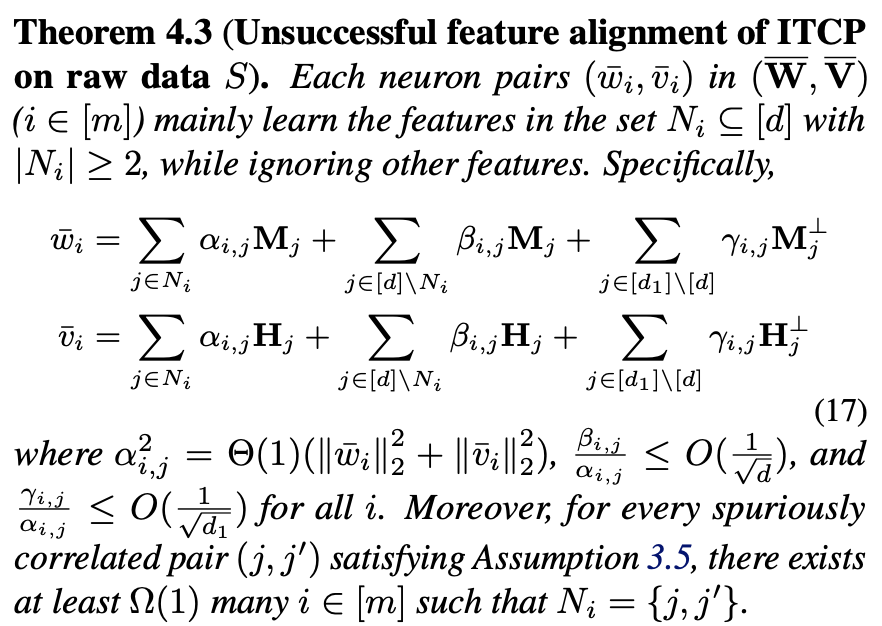
• Theorem 4.3에서 제시된 바와 같이, raw data에서 학습된 모델은 이미지-텍스트 쌍 간 잘못된 상관관계로 인해 feature alignment을 제대로 이루지 못함
• 그러나 synthetic data로 훈련된 모델은 spurious correlations 줄어들어 feature alignment 잘 이루어짐
이를 통해 zero-shot classification에서 높은 성능 얻을 수 있음
4.2 Zero-Shot Classification Performance
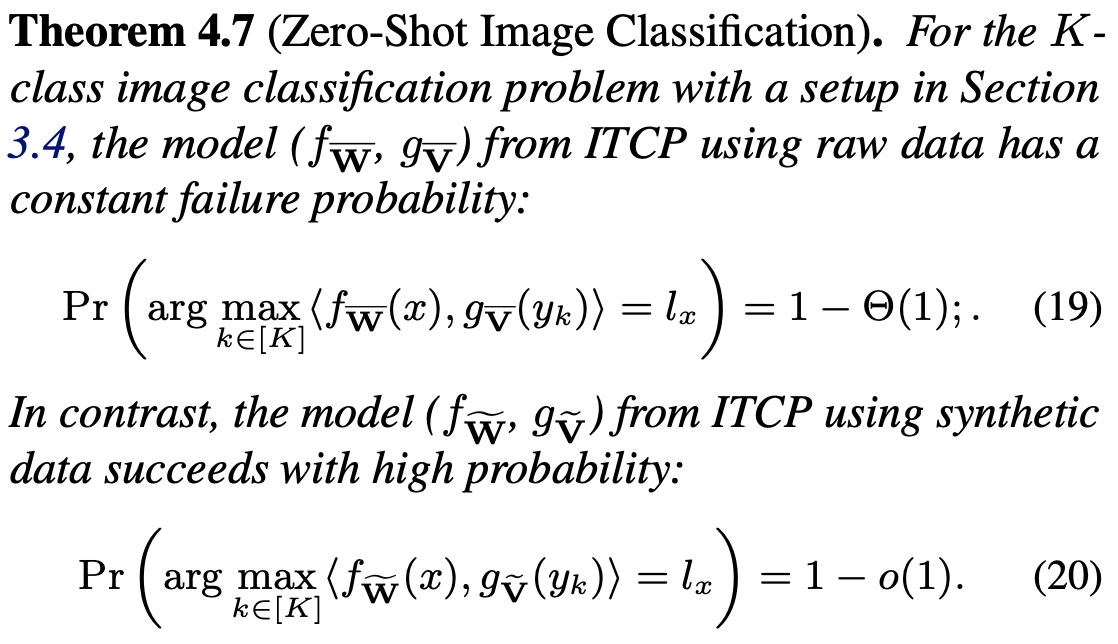
• Theorem 4.7에 따르면, synthetic data로 훈련된 모델은 zero-shot 분류 성능이 raw data로 훈련된 모델보다 way better~
이론적으로 synthetic data 사용하면 out-of-domain data에 대해서도 높은 정확도 보임
5. Experiment
5.1 Simulated Experiment
• synthetic data 사용한 모델이 zero-shot classification에서 높은 정확도 기록했다 함
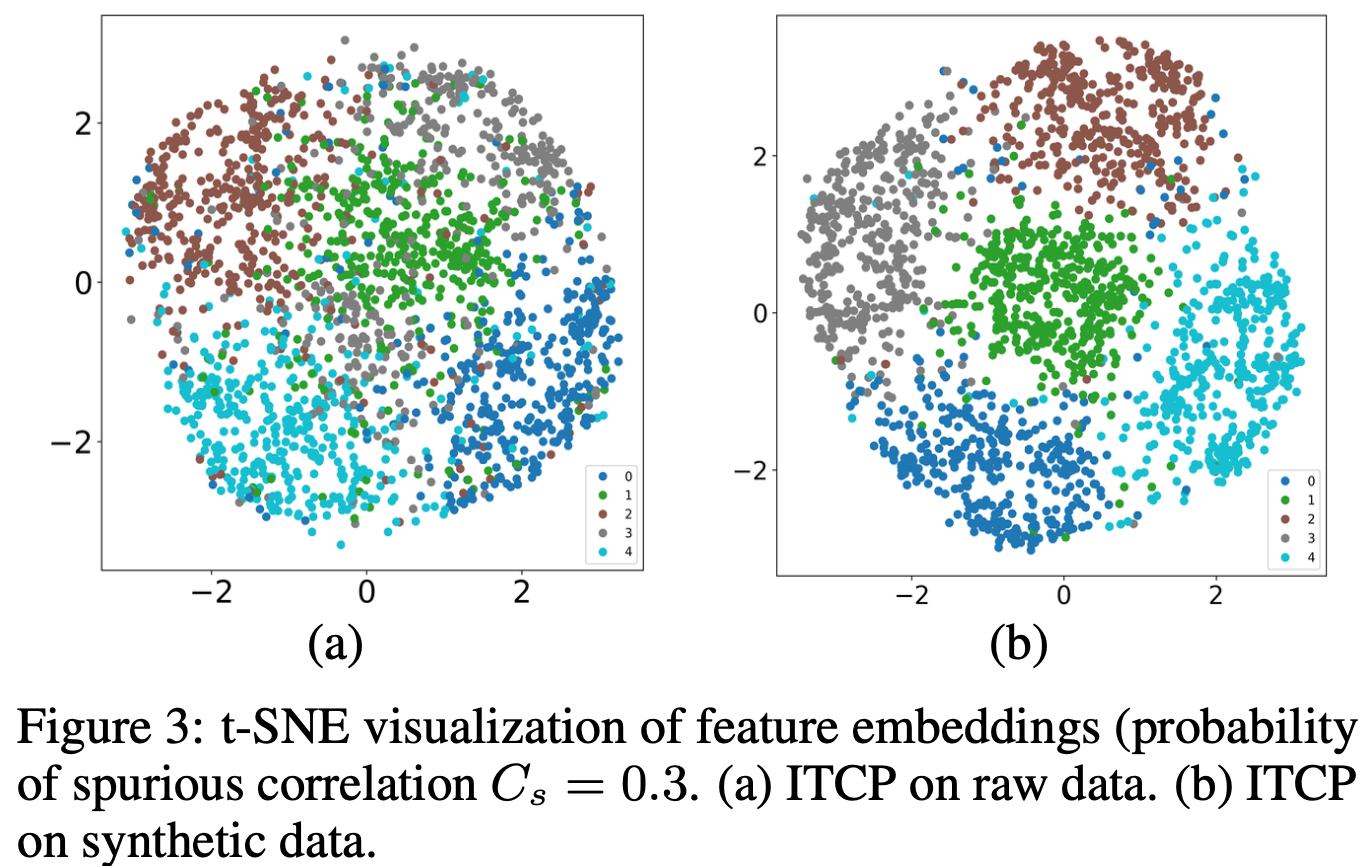
• synthetic data로 훈련된 모델이 raw data로 훈련된 모델보다 feature embedding이 더 잘 분리됨
5.2 BLIP Model Experiment
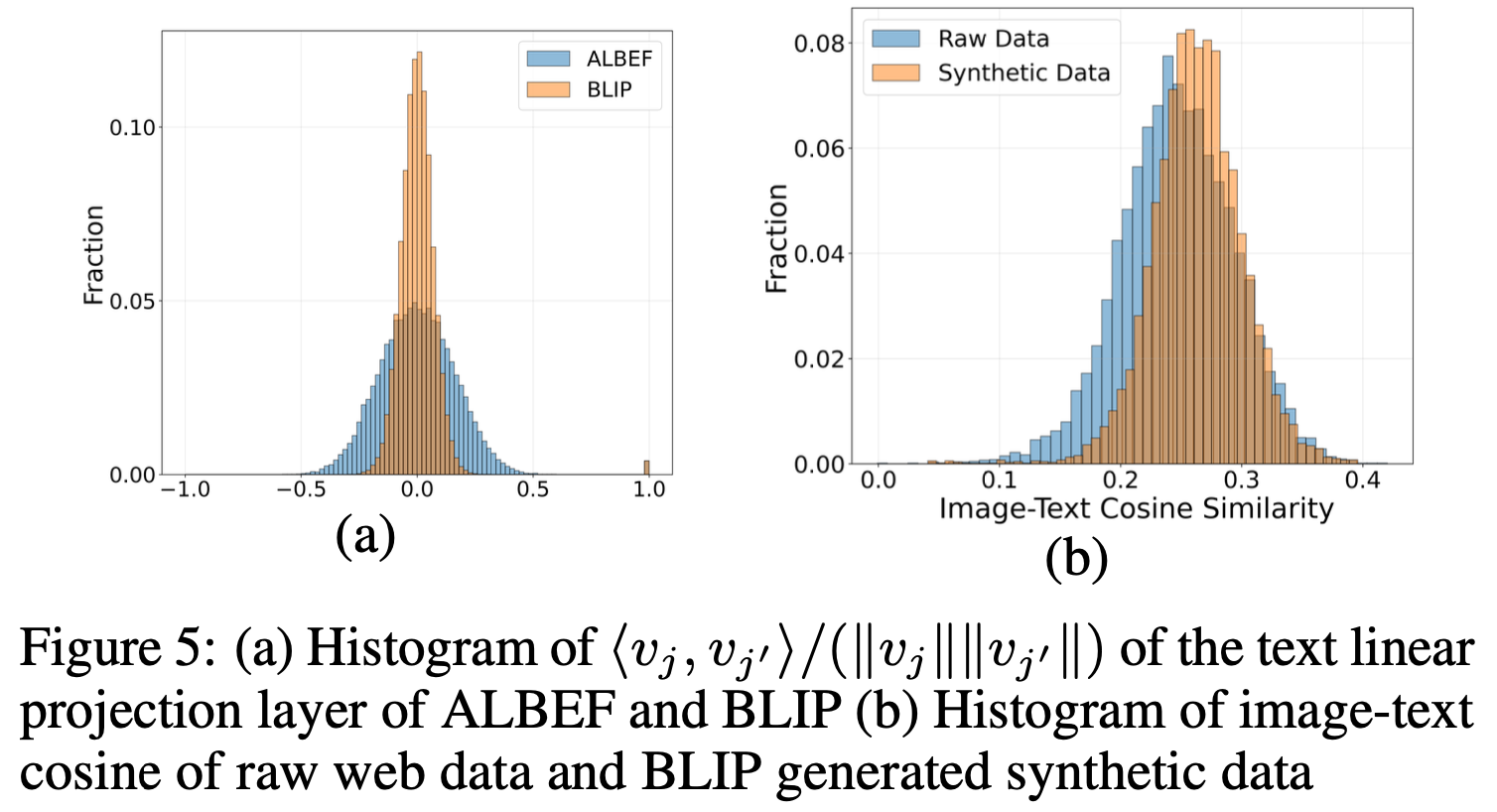
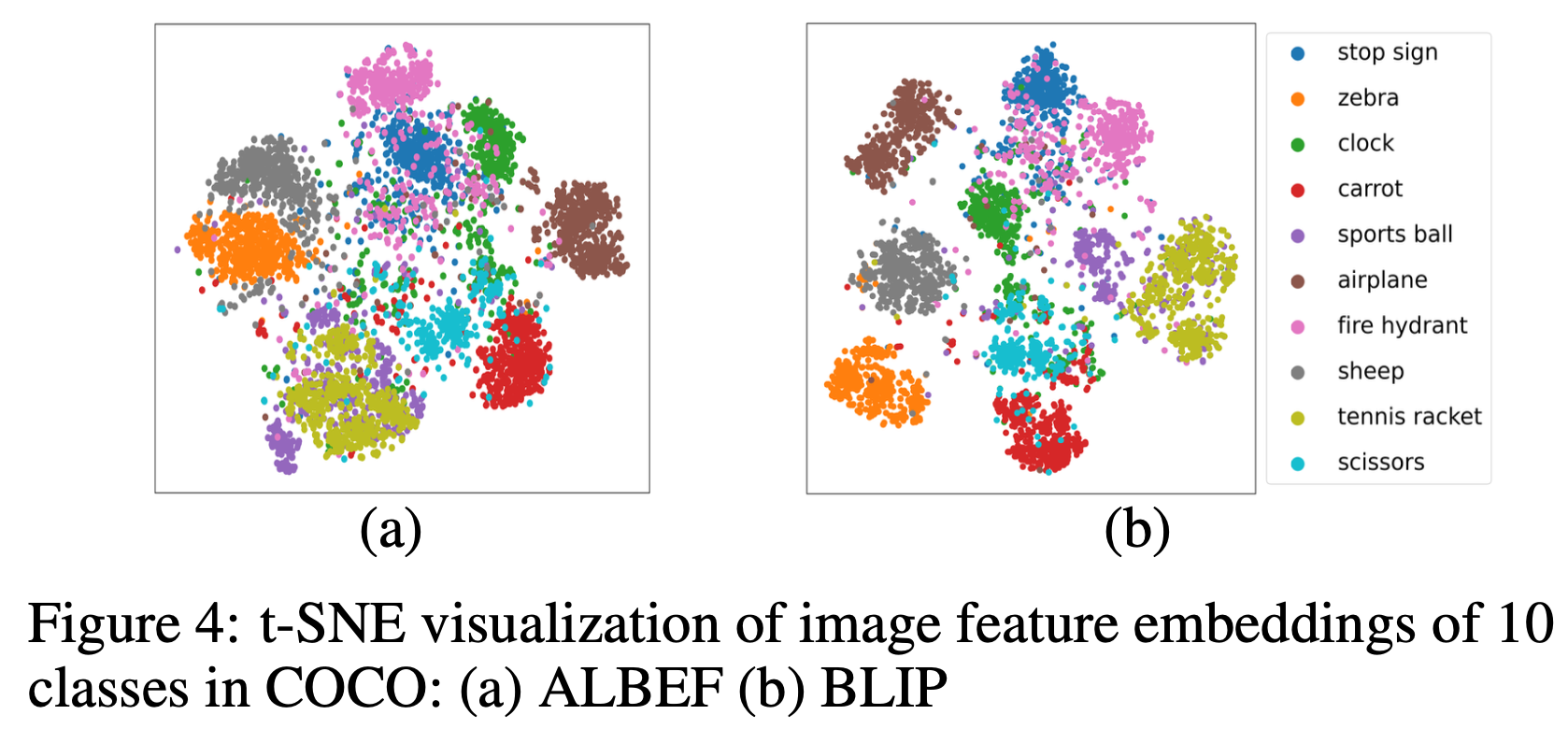
• synthetic text captions이 raw captions보다 더 나은 feature alignment 도출
-> synthetic captions을 통해 generalization 성능 향상됨
6. Conclusion
• synthetic text captions이 VLMs에서 feature alignment 향상시키고,
zero-shot generalization 성능을 크게 개선할 수 있다는 연구 결과 제공
• future work : Transformer architectures 같은 복잡한 모델에 대한 분석과
image-text retrieval 등 더 복잡한 작업에 적용할 가능성 연구 필요
Review
1. Summary of the Paper
This paper provides a theoretical analysis of how synthetic text captions can improve image-text feature alignment and enhance zero-shot classification performance in Vision-Language Models (VLMs). The paper argues that synthetic captions help mitigate spurious correlations that arise during contrastive learning, offering a solution to this issue. Experimental results with the BLIP model show that synthetic captions lead to better performance in zero-shot classification and improve feature alignment.
2. Claims and Evidence
- Claim: The paper claims that synthetic captions improve feature alignment and enhance zero-shot classification performance, thus addressing the issue of spurious correlations in contrastive learning.
- Evidence: The claim is supported by experiments with the BLIP model, where the use of synthetic captions significantly outperforms models using raw captions in terms of zero-shot accuracy. Additionally, feature alignment improves when synthetic captions are used.
3. Methods and Evaluation Criteria
- Methodology: The paper utilizes contrastive learning in VLMs, where synthetic captions are used to improve feature misalignment. Image-grounded text decoders generate the synthetic captions, which replace problematic image-text pairs in the training data.
- Evaluation Criteria: The paper uses zero-shot classification, feature alignment, and reduction in spurious correlations as key metrics for evaluating the effectiveness of synthetic captions.
4. Theoretical Claims
- Claim: The theoretical claim is that synthetic captions reduce spurious correlations and improve feature alignment, thereby enhancing zero-shot generalization performance in VLMs.
- Supporting Evidence: The paper provides a theoretical framework using contrastive loss to explain how synthetic captions alleviate feature misalignment and improve model performance.
5. Experimental Designs or Analyses
- Design: The experiments are based on the BLIP model, and the paper shows that synthetic captions improve zero-shot classification performance. t-SNE visualizations illustrate how synthetic captions enhance feature separation in the model.
- Analysis: The results demonstrate that the use of synthetic captions leads to a noticeable increase in zero-shot accuracy and better feature alignment compared to models using raw captions.
6. Supplementary Material
- Supplementary Material: The paper includes important formulas and experimental results, but it lacks detailed information on the implementation of the synthetic captions generation process and the image-grounded text decoders.
- Additional Suggestion: Providing implementation code or notebooks would make it easier for other researchers to replicate the experiments. Additionally, further details on the experimental environment (e.g., hardware used, training time) would improve the credibility of the results.
7. Relation to Broader Scientific Literature
- Relation to Literature: This paper introduces a new approach to synthetic captions for improving feature alignment in contrastive learning, addressing a gap not extensively explored in previous research. It connects to existing studies on spurious correlations and contrastive learning in VLMs.
- Differentiation: The paper distinguishes itself by proposing the use of synthetic captions, which solve issues found in raw captions used in prior work. This marks a significant contribution to VLM training.
8. Essential References Not Discussed
- References: The paper references key works related to synthetic captions and contrastive learning, but more citations could be included for the related research on synthetic text generation and image-grounded text decoders.
- Additional Suggestion: It would be useful to include references to recent advancements in self-supervised learning methods, such as DINO and SwAV, and discuss how these might influence the generation of synthetic captions.
9. Other Strengths and Weaknesses
- Strengths: The paper introduces an innovative method for addressing spurious correlations in VLMs, making a significant theoretical contribution. The experimental results are convincing, showing the benefit of synthetic captions.
- Weaknesses: The study is limited to experiments with the BLIP model, and there is a lack of real-world dataset validation. Additionally, the generation process for synthetic captions needs further clarification.
10. Other Comments or Suggestions
- Suggestions: The paper would benefit from experiments using synthetic captions across a broader set of VLM models and the inclusion of Transformer-based models. It would also be valuable to explore synthetic captions in real-world data to validate the approach under different conditions.
- Experiment Diversification: More experiments with real-world datasets would increase the robustness of the findings.
11. Questions for Authors
- Could you elaborate on any potential issues (e.g., mismatches between image and caption) in generating synthetic captions?
- Do you believe the performance improvement seen in the BLIP model would hold across other VLM models? Please provide more details on that.
Overall Recommendation
Weak Accept
- This paper presents a strong contribution by using synthetic captions to address the issue of feature misalignment in VLMs. The theoretical and experimental aspects of the paper are promising, but additional explanations and experiments would solidify the claims made in the paper.
1. While the evidence is convincing, the experiments are limited to the BLIP model. Further validation with other VLMs and real-world datasets is needed to strengthen the findings.
2. The methodology would benefit from more detailed explanations of the synthetic captions generation process and the role of temperature parameter (τ) in the contrastive loss function. Providing more technical clarity on these aspects would enhance the understanding of the approach.
3. The experiments are limited to the BLIP model, and the findings need further validation across a wider range of VLMs. Ablation studies would also strengthen the evidence by isolating the impact of synthetic captions more explicitly.
4. Including more detailed implementation details and environmental setup would help increase the reliability of the experimental findings.
5. It would be helpful to discuss how synthetic captions could apply to other domains, such as image-sound or video data. This would broaden the scope of the proposed approach and highlight its versatility.
6. More experiments with real-world datasets would increase the robustness of the findings.
'Visual Intelligence' 카테고리의 다른 글
| YOLO 이상행동 탐지 프로젝트 흐름 (0) | 2026.02.27 |
|---|---|
| [ 논문 리뷰 피드백 ] 2월 - Synthetic Text Captions (0) | 2025.03.03 |


